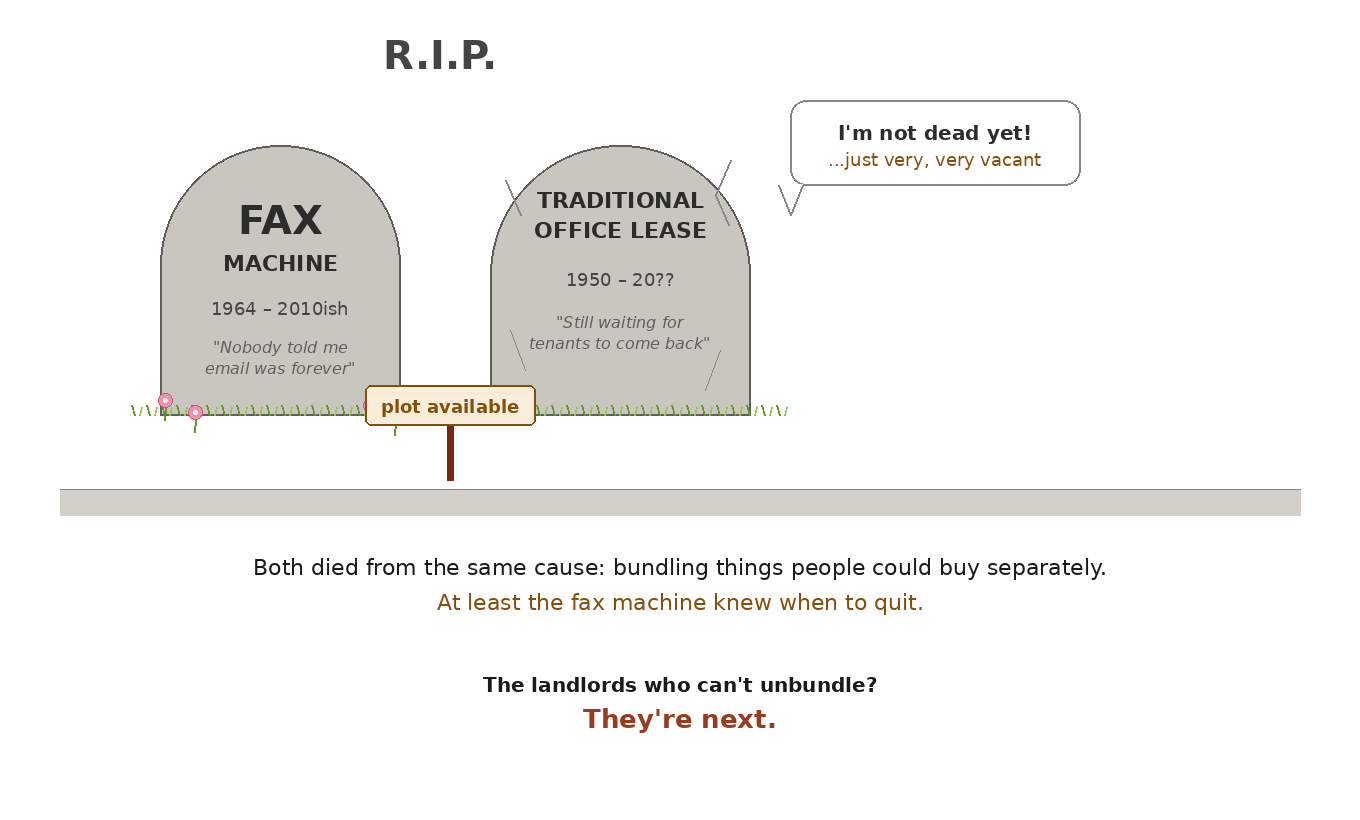
Fax machines were just low-res scanner-printer combos. Nobody talks about them that way, but that's what they were.
The manufacturers had every component they needed to evolve — better resolution sensors, portable form factors, eventually software and apps. They had the hardware engineering talent, the distribution channels, the installed base, and the service relationships. They could have said: "We're not in the fax business, we're in the document capture and transmission business."
That reframe would've pointed them toward standalone scanners, multifunction printers, portable document scanners, and eventually software-based document management — products that Fujitsu (ScanSnap), HP, and Adobe ended up dominating instead.
But they didn't. Because the fax business model was too comfortable. Recurring toner revenue. Service contracts. Captive customers who needed to communicate with other fax users. Redefining the product meant cannibalizing the annuity. So they rode the legacy model down.
Sound familiar?
A traditional office lease is the same kind of bundle hiding in plain sight: physical space + mailing address + professional environment + meeting rooms + internet infrastructure + community + a signal of legitimacy. Landlords have been selling that bundle as a monolithic 5-10 year commitment. One box. Take it or leave it.
The fax pivot that never happened would've looked like this: unbundle the scanner from the printer, go higher-res, go portable, go software. The office lease pivot maps perfectly onto that same progression.
The "standalone scanner" move — virtual offices and mail handling. You don't need 3,000 square feet to have a business address, mail service, and a receptionist. This is the lightest-weight product, and it monetizes the building's identity without requiring physical occupancy. Low cost to deliver, high margin, huge addressable market of remote-first companies and freelancers who just need the professional front-end without the space.
The "multifunction printer" move — flex memberships with à la carte services. Instead of "here's your suite, see you in seven years," it's "here's a membership tier, add meeting rooms and printing and phone booths as you need them." You're selling access and optionality, not square footage and duration. This is the coworking model done right — the components are the same as a traditional lease, just repackaged so the customer only buys what they actually use.
The "portable scanner" move — pop-up and satellite spaces. Companies that went remote still need to gather sometimes. A landlord with multiple properties or partnerships could offer roaming access — your team is in LA this week, New York next month, and you have workspace in both. The asset stops being a single building and becomes a network. Same way portable scanners freed document capture from the desk, satellite access frees office from a single address.
The "mobile app" move — platform and community. The most ambitious version. The landlord stops thinking of themselves as a real estate company and starts thinking of themselves as a platform for how work gets done. Member directories, event programming, warm introductions between tenants, partnerships with service providers. The physical space becomes the anchor for a digital ecosystem. This is where the margin eventually migrates — from rent per square foot to value per member.
Here's the part that kills me. Fax makers didn't lose to one competitor. They lost to an ecosystem — email, cloud storage, DocuSign, Slack — that collectively made the fax irrelevant by solving the underlying needs better and more flexibly.
That's the same dynamic playing out with traditional leases right now. The replacement isn't coworking. It's a spectrumof options — virtual addresses, day passes, flex memberships, satellite networks, community platforms — that collectively render the 7-year NNN lease as the thing you maybe still offer, but definitely not the thing you lead with.
So why won't most landlords make the pivot? Same reason fax manufacturers didn't.
The legacy economics are too seductive right now, even as they're deteriorating. A traditional landlord with a half-empty building and a mortgage structured around $4/sq ft gross rents can't easily pivot to $300/month memberships without blowing up their debt service coverage ratio. Their lender doesn't want to hear about community programming — they want to see a signed 7-year lease from a law firm.
So most will do what fax manufacturers did: keep selling the old product at a discount, watch utilization decline, and eventually either get acquired by someone with a flex model or let the asset get repurposed entirely — converted to residential, mixed-use, whatever pencils out.
The manufacturers who did survive — Brother, Canon, Ricoh — did so by quietly evolving into multifunction device and document management companies. They didn't announce "fax is dead." They just started offering better versions of the useful components while letting the fax function become a vestigial feature that eventually disappeared from the product line entirely.
That's probably the smartest playbook for landlords too. Don't declare the traditional lease dead. Just keep expanding the menu of lighter, more flexible options until the long-term lease becomes the legacy add-on that a few tenants still want, rather than the core product.
The building doesn't change. The business model around it does.
#coworking #cre #office #flexwork